
Injuries to the Anterior Cruciate Ligament (ACL) of the knee have traditionally been treated with surgical reconstruction, with failure rates reported at less than 2% per year. 1 Recently there has been interest in bracing techniques in an attempt to allow the ACL to heal without surgery, e.g. the Cross Bracing Protocol (CBP), and others. Imaging studies have been cautiously optimistic about healing of a ruptured ACL by bracing.
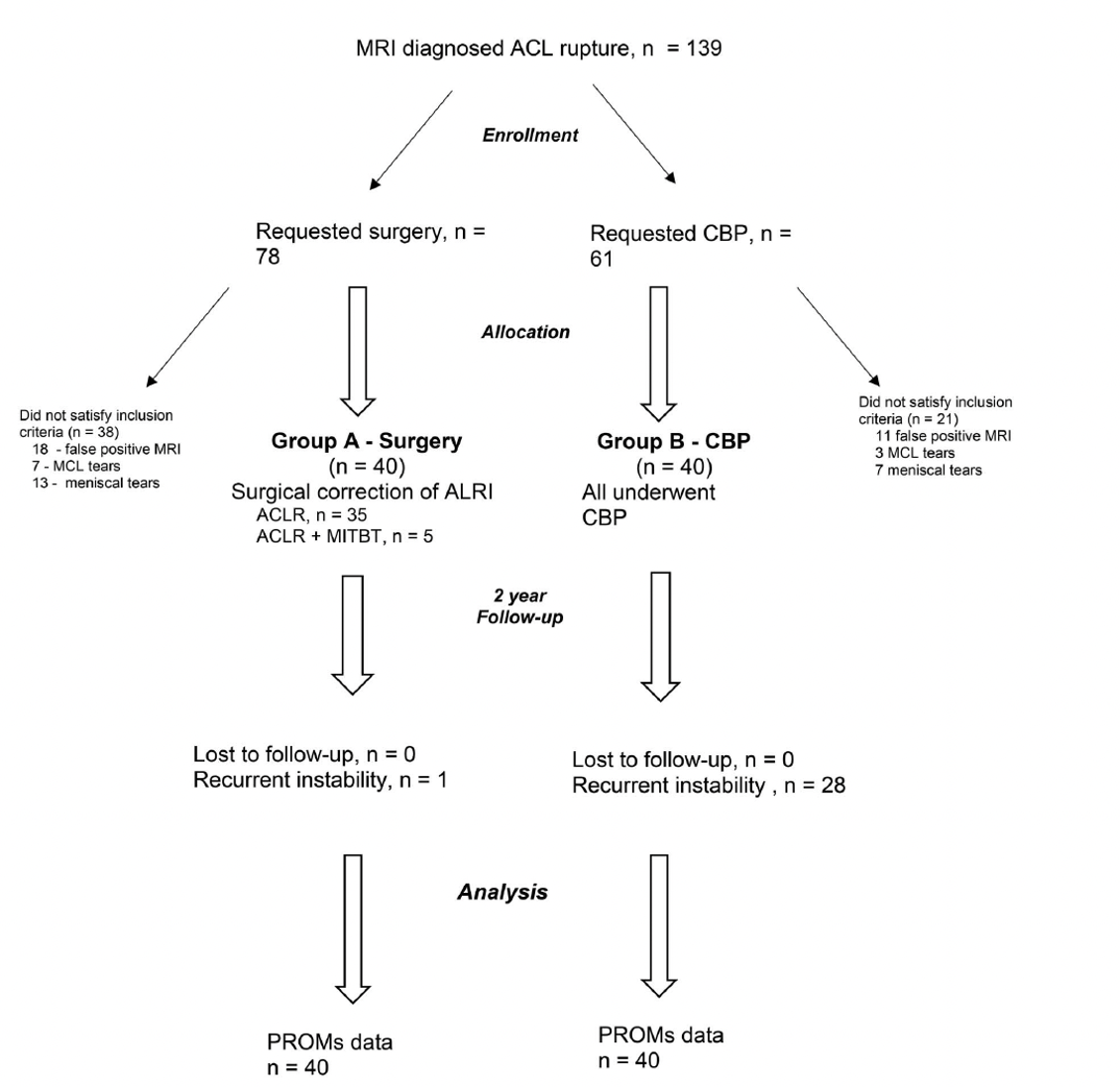
However, a recently published paper reports on prospective, matched cohort of 80 patients with an ACL rupture, involved in pivoting sports. Half were treated surgically, the other half with the CBP. After two years, the surgical group had a 1% rate of further instability, but the CBP group had a 70% rate. Rates of medial meniscal injuries were also much higher in the CBP group (62% vs 2.5%).
While avoiding surgery sounds appealing, it seems some way off before bracing alone can be considered an option for getting people back on the playing field. Surgical reconstruction remains the Gold Standard.
- Porter M, Shadbolt B. Modified iliotibial band tenodesis versus lateral extracapsular tenodesis, to augment
anterior cruciate ligament reconstruction: a 2-year randomized controlled trial. ANZ J Surg. 2022; 92:2247–2253. - Filbay SR, Dowsett M, Chaker Jomaa M, et al. Healing of acute cruciate ligament rupture on MRI and outcomes
following non-surgical management with the Cross Bracing Protocol. Br J Sports Med. 2023; 57:1490–1497. - Porter M, Shadbolt B. Cross Bracing Protocol for Anterior Cruciate Ligament (ACL) Rupture Has Unacceptably
High Failure Rate Relative to Surgical Stabilization: A 2-year Controlled Cohort Study. Clinical Journal of Sport
Medicine, February 2, 2026. DOI: 10.1097/JSM.0000000000001416