
Reducing the risk of Deep Vein Thrombosis (DVT) after surgery

A Deep Vein Thrombosis (DVT) is a clot that can occur within the veins of the leg and pelvis before, during or after surgery.  They can move up to the lung, and at its worst – can be fatal.  If every patient having a joint replacement operation has an ultrasound of the calf – 10-20% will have a small clot, which often does not require any change of treatment.

How do I minimize the risks of developing a DVT?
• Walking, moving your foot up & down, contracting the calf muscle
• Compression Stockings. They help with promoting venous (blood) returning into the circulation reducing swelling in the lower leg
• Aspirin, or other blood thinning medications, are routinely used for 6 weeks after surgery
• Avoid inactivity for extended periods of time – if allowed to walk – walk every hour in daylight hours.  If watching the TV, foot up & down exercises at every add break.  If reading, foot exercises at the end of every article or page
• Put your leg up – lying down is much better than bolt upright with a footstool.  Lounge suite is good (except if recent hip replacement)

What symptoms would suggest a DVT?
• Pain and tenderness of the calf
• Swelling of the calf not resolved with elevation
• Severe, unexplained pain in your foot, ankle or calf
• Chest pain or shortness of breath could mean a clot in the lung (this is very serious)

What if I do get a DVT?
Depending on the size and location of the blood clot determines the treatment. Small clots below the knee are treated with compression stockings and tablets – blood thinning agent (Aspirin) and keeping moving. In some instances stronger blood thinning agents are required (e.g. clexane, warfarin)

If you, or a family member, have had a blood clot before, you MUST tell your surgeon to ensure additional preventative steps are taken.
Admission to hospital

Patients are generally admitted on the day of surgery to the hospital through the Surgical Admission Unit. Same day admission has successfully reduced the risk of post-operative infections.

What can I eat or drink before surgery?
Prior to surgery, no solid food is permitted for six hours. This typically means midnight for morning operations, and 7am for planned afternoon operations.  The hospital will be in contact in the 24 hours prior to surgery to confirm the times.
You are permitted Powerade & CLEAR FLUID up until 2 hours prior to surgery.

For St John of God: We generally ask that you have half or more of a bottle of Powerade an hour before you were due at the hospital.
For Ballarat Day Procedure Centre, you should have your last drink 1.5 hours before you are due there.
Clear fluid means black tear or coffee, water based drinks & water.  MILK & milk containing drinks are NOT included in this list.

What do I bring to hospital?

You will only be staying a few days, so don’t bring too much.
Wear to hospital the clothes you will wear home.
Nightshirts and boxer shorts allow for easier access for dressings/ bandages / having the wound attended to & topped up with local anaesthetic agents.
A second set of night attire allows for any drama like needing to wash the first set.
Bring some magazines, but don’t bother with laptops.
Some people like to bring their mobile phone /ipad /kindle.
Don’t bring/wear jewellery.

Airport Alarms

The most commonly used materials in joint replacement surgery include titanium, stainless steel and cobalt-chrome.  Metal detectors used at airports SHOULD pick these up, along with everyday items (belts, buckles, & steel strengthened RMW boots).

When planning a trip to the airport there are a few things that will make the experience easier without causing unnecessary delays:
• Be prepared that your new joint may be detected
• Inform security staff that you have a hip/knee/shoulder replacement
• Wear clothing that allows for easy access to show the surgical scar. Be prepared that you may be required to show the scar to security staff
• Some orthopaedic companies provide a card that states you have a metal implant.
​   However, the security staff will usually ask you to step aside for further screening
• You will likely be screened with a metal detecting wand
• Airport security staff are familiar with travellers with joint replacement and generally deal with them without causing undue delay

​The best thing to do is remain calm. Your goal is to move through the process as quickly as possible by letting security staff do their jobs.
​And importantly, enjoy your holidays.

What to expect after foot surgery

Generally, you will be in a plaster back-slab, or have a bulky dressing, for 10-16 days after foot surgery. You will be non-weight bearing (unable to walk on the operated foot).
At the review appointment with the surgeon the sutures will be removed.

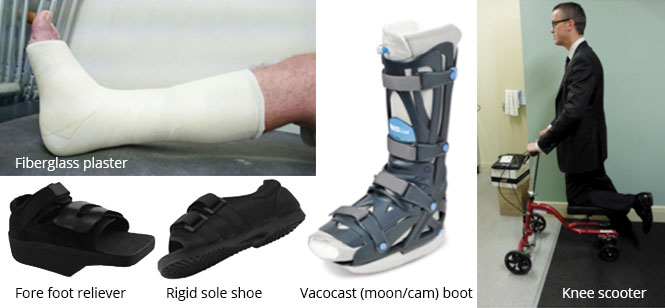
Depending on the procedure you have had, will determine the type of footwear for the next stage of recovery- these include
• Vacocast Boot (Moon Boot)
• Fibreglass Plaster
• Rigid sole shoe
• Fore foot reliever shoe
• No special footwear required.

After some foot surgery it’s not possible to walk on that leg for six weeks or more – consider hiring a knee scooter.   A knee scooter can help enormously with independence after surgery.

Discuss with your surgeon the anticipated period of non-weight bearing /type of footwear required post surgery.

Getting ready for surgery

Simple, basic, preparation can make a world of difference to your postoperative recovery. It allows you to concentrate on recovering from surgery without the extra stresses associated with daily life.

Things to consider

  • Roll up mats and other tripping hazards
  • Rearrange furniture- allow for easy access to door way, bathrooms etc
  • Remove pot plants that clutter verandahs, doorways & paths
  • Roll up the garden hoses/ have ease of access to garden paths & gates.
  • Stock up the pantry, fridge and freezer
  • Have meals planned and prepared
  • For those that are isolated from shops, consider some long life milk in the pantry and bread in the freezer.
  • Organise pets. Plan ahead with canned pet food to make shopping after surgery less troublesome (and lighter).
  • Plan the care of your pets whilst in hospital (neighbours/kennels)
  • Attend to those odd jobs around the house prior to surgery (light globes etc.)
  • Change bed sheets/towels prior to day of surgery- takes the stress away from dealing with washing/drying of heavy items
  • Organise/coordinate family, neighbours and friends. If you live alone: having someone that can drop in daily is ideal. If you don’t have people that can drop in, arrange family/friends to contact you on a daily basis. In this situation it is preferable if they can contact you morning and night to check all is okay.

Preparation can make a huge difference.

Injections into the knee

There are a variety of treatments to relieve the symptoms of osteoarthritis in the knee. In arthritis, the surface of the bone becomes damaged. This damage can cause swelling, stiffness, pain and disability. One treatment option is to inject corticosteroids into the knee. Corticosteroid injections can be useful for treating flare-ups of osteoarthritis and help relieve symptoms by reducing inflammation in the joint. Injections may be beneficial for people who are unable to take non-steroidal anti-inflammatories (NSAIDS), and for people who have not had relief from NSAIDs (voltaren, ibuprofen, celebrex, mobic).

The procedure

  • You will be seated with your legs hanging over the side of the examination table.
  • The skin will be prepped with an alcoholic chlorhexidine.
  • The surgeon may use a needle to draw out any extra fluid that is in your knee.
  • The steroid is mixed with local anesthetic and injected, usually just below your kneecap.
  • Generally the injection is not painful
  • A small bandaid is applied to the injection site.

What to expect after the injection

  • you are able to drive
  • the local anaesthetic generally wears off in 2-3 hours. You may experience some pain and discomfort. Paracetamol (panadol/panamax) is advised to relieve discomfort initially.
  • the steroid effect usually works within 24 to 48 hours
  • applying ice to the area (not directly on the skin) can be beneficial
  • rest the affected area for 24 hours
  • avoid strenuous activity for several days
  • the pain relief lasts from 6 to12 weeks
  • steroid injections are not considered a long term solution

PRP (Platelet Rich Plasma Injections) & Durolane Injections

There are some patients that may benefit from a more complex injection than a simple steroid injection.  PRP involves taking some blood, extracting the platelets, and then injecting 3-5ml of platelets into the joint or tendon.  The broad principles above apply.  Durolane is a synthetic lubricant of joints (hyaluronic acid) like your body usually produces.  If the joint is very swollen, the existing fluid is removed before injecting the new.

Durolane and Synvisc are occasionally used for arthritic joints.  They cost approximately $500.  80% of patients feel that they have a worthwhile result for six months or more.  Patients with an egg allergy cannot use Synvisc.  Again, the broad principles above apply.

Looking after a plaster cast

Casts are usually made from either plaster (plaster of paris) or fibreglass. Plaster is often used in the early stages of treatment because it can be moulded/shaped more accurately (eg. for wrists/forearm).

Plaster back-slabs (plaster that does not fully enclose the limb) are often used in the first few weeks after surgery to allow for swelling and to check wounds.
Fiberglass casts are lighter and more durable. They are often put on after stitches have been removed and swelling controlled.
Keep the arm/leg elevated as much as possible.

Remember-Elevate, Elevate, Elevate!

Arm

  • rest the arm on pillows when sitting or lying down
  • resting on a sofa with your arm across the back is ideal
  • use the sling provided as instructed/advised

Leg

  • when sitting or lying prop the leg up on pillows.
  • just going to the toilet a few times a day means the leg is down for an hour and it can take a whole day of keeping the leg up to correct this.
  • the first two weeks are not the time to go out socialising.

Swelling

  • Swelling of the fingers or toes around a cast is common
  • Minimise swelling by elevating the leg/arm
  • Move the fingers/toes to help keep the blood circulating

How do I look after the cast?

  • Keep the plaster dry
  • Wet casts can itch, smell and be uncomfortable
  • In the shower- cover the plaster with a garbage bag & seal with tape
  • Don’t be tempted to itch the skin under a cast with anything (chopsticks, pencil, knitting needles, rulers, or coins).  This can cause skin irritations, and result in infections under the cast
  • Don’t put creams or powders on the skin under the cast

What if there is a problem with my cast?
Most cast problems are minor, but there are a few signs to be aware of when you have a cast-

  • Severe pain
  • Damage to the cast- areas of moisture, odour, discharge
  • Pins & needles or numbness
  • Unable to move fingers or toes
  • Change in color to the skin
  • Change in temperature to fingers or toes

Mild symptoms should be relieved by elevating the arm/leg and taking simple painkillers.  Otherwise, it may become an emergency that the blood flow is restricted and you may need to attend the emergency department even at midnight.

If you think there is a problem with your cast, you should contact your doctor.